

If you’d asked me in 2010 what the designer’s toolbox would look like in 2030, I’d have imagined something simple: pen, paper, maybe a trusty mouse — tools I understood and trusted. I’ve been designing digital interfaces long enough to have seen the discipline evolve from ad-hoc problem solving to the structured, UX-driven workflows we take for granted today.
We are living through what might be the most profound shift in a designer’s workflow since the mouse replaced the drafting board — and by 2030 it won’t just be about the tools we use, but the mindset we bring to the table. The big question isn’t “Will AI replace designers?” — it’s “Will your design practice be AI‑first, AI‑assisted, or left behind altogether?”
Designers don’t stop being designers because tools change — they stop being designers when they forget who they design for.
Some say AI is here to take jobs; others say it’s here to elevate work. Figma’s CEO, Dylan Field, recently reminded the design world that while AI can generate visuals, it still lacks the cultural context and emotional resonance that human designers bring to their craft — a nuance no seasonal AI can replicate. Field’s perspective underlines something essential: “AI won’t replace designers, but designers who ignore AI might be replaced by those who don’t.” Business Insider[1]
The future isn’t binary — it’s collaborative. AI isn’t a robot Picasso waiting in the wings; it’s more like a tireless assistant who never sleeps, never judges, and can take on the tedious parts of the craft, leaving the human designer free to make the judgment calls that actually matter.
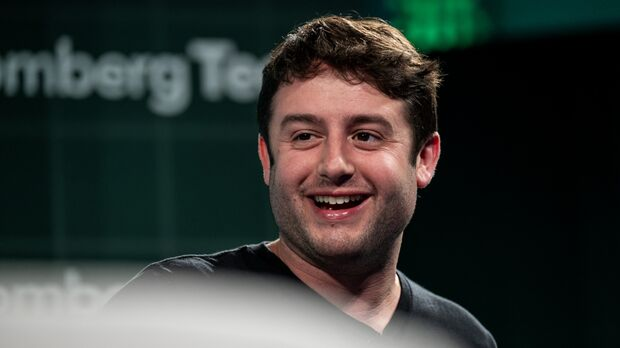
Dylan Field, co‑founder and CEO of Figma, at the Figma IPO ceremony — photo via Bloomberg
By 2030, the day-to-day work of UX and interaction designers could look fundamentally different:
- Prototyping becomes conversational. Instead of painstakingly building artefacts from scratch, designers might talk to their tools — sketching through voice prompts or conversational interfaces — shifting the labour from manual construction to high-level direction.
- Data synthesis isn’t an ordeal, it’s ambient. AI will crunch research and analytics in real time, offering insights and opportunities alongside your design decisions. Think of it as having an assistant who not only organises your desk but reads every user interview you’ve ever conducted. This flips the old model of “analyse → iterate → repeat” into a smooth, interactive feedback loop that’s constantly learning.
- Ethics and empathy are front and centre. As Geert Hofman argues in his work on the ethics of generative AI in creative processes, designers will need to think beyond form and function to responsibility and trustworthiness within AI-augmented systems. arXiv [2]
- Nonlinear co‑creation is the norm. AI won’t just follow instructions; it will be trained to discuss, question, even push back. Human-AI co-design research predicts AI evolving from passive executor to “opinionated colleague,” reshaping how we iterate and refine ideas. arXiv [3]
Empathy remains irreplaceable — machines may predict interactions, but only humans can feel why a design matters.
So what do you need to thrive as a designer in 2030? Ironically, it’s less about memorising commands and more about the distinctly human facets of practice:
- Curiosity over command syntax. Tools will become easier; asking the right questions will remain hard. Deep curiosity — about users, about edge cases, about nuance — will be a designer’s superpower.
- Curiosity over command syntax. Tools will become easier; asking the right questions will remain hard. Deep curiosity — about users, about edge cases, about nuance — will be a designer’s superpower.
- Empathy remains irreplaceable. Machines may predict interactions and propose layouts, but understanding why a design feels right or feels oppressive requires human sensibility.
- Ethical thinking will be table stakes. Designers will need frameworks for understanding not just what a system does, but the impact of what it does.
- Meta-design thinking. Designers will need to think not just about interfaces, but about the ecosystems that host AI — from data quality to unintended outcomes.
In other words, it’s less about learning a specific AI tool and more about shifting the designer’s mindset.
The future of design will be less about human versus machine, and more about human with machine.
Let’s unpack these terms without getting lost in marketing speak:
- AI‑Assisted Design is what we’re mostly doing today: using AI to expedite research, generate ideas, or accelerate prototyping. AI helps, but you still own the lead role in decision-making.
- AI‑First Design envisions a future where the workflow itself is co‑designed with AI from day zero: tools not only help shape outputs but influence the very way problems are framed and solved.
By 2030, the lines between these models will blur. The more fluent you are in guiding AI — through prompts, context, and constraints — the more you’ll benefit from its generative and analytical capacities.
If you find yourself thinking “AI will never replace my craft,” that’s not complacence — it’s a strategic insight. If, instead, the thought is “AI will do my job,” then it’s time to rethink the toolbox you’re building.
Yes, AI is rapidly advancing. But as every sensible designer knows, aesthetics alone don’t make a good experience. Field makes a witty yet pointed observation: AI still struggles to capture cultural nuance — something as simple and iconic as Charli XCX’s album cover wouldn’t necessarily emerge from an AI’s suggestion engine, because the emotional context matters. Business Insider [1]
If you find yourself thinking “AI will never replace my craft,” that’s not complacence — it’s a strategic insight. If, instead, the thought is “AI will do my job,” then it’s time to rethink the toolbox you’re building.
Designers in 2030 won’t be replaced by AI — but they might be outpaced if they don’t adapt.
We won’t carry fewer tools; we’ll carry different ones. The pencil will still matter — metaphorically if not literally — but it will sit alongside an array of intelligent assistants that amplify our reach and test our thinking.
The future of design will be less about human versus machine, and more about human with machine: collaborative, reflective, ethical, and above all human-centred in a world that’s increasingly algorithmic.
[1]: https://www.businessinsider.com/figma-ceo-charli-xcx-brat-ai-versus-human-designers-2025-11?utm_source=chatgpt.com “Figma CEO says Charli XCX’s ‘Brat’ album cover is an example of why AI won’t replace humans anytime soon”
[2]: https://arxiv.org/abs/2412.03579?utm_source=chatgpt.com “Towards a Practical Ethics of Generative AI in Creative Production Processes”
[3]: https://arxiv.org/abs/2401.07312?utm_source=chatgpt.com “Understanding Nonlinear Collaboration between Human and AI Agents: A Co-design Framework for Creative Design”
Resources
Artificial Intelligence: A Guide for Thinking Humans by Melanie Mitchell
A thoughtful overview of AI that keeps human cognition and limitations in view.
Design Thinking with Artificial Intelligence by Daniel Graff, Mark A. Clark, Dan Li & Lei Xia
Practical methods combining AI with design thinking frameworks.
The Age of Intelligent Machines by Ray Kurzweil
A classic on how intelligent systems may evolve in our world.
The Design of Everyday Things by Don Norman
While not about AI per se, it remains essential for clear human‑centred thinking in a tech‑rich age.
Fluid Concepts and Creative Analogies by Douglas Hofstadter
Offers deep insight into cognition and analogy — a core challenge for generative systems.
0 Comments